
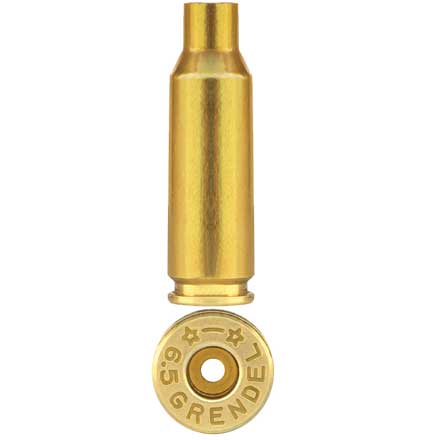

Premium 6.5 Grendel Reloading Cases: Dimensions & Specs
Achieving match-grade accuracy and reliable feeding from the 6.5 Grendel platform depends directly on component quality. Designed specifically to push AR-15 magazine dimensions to maximum ballistic efficiency, high-grade 6.5 Grendel reloading cases serve as the backbone for custom hunting and precision long-range handloads.
Understanding exact dimensional tolerances, metallurgy, and brass preparation ensures handloaders maximize case life, maintain tight velocity spreads, and unlock the full capability of this efficient intermediate cartridge.
Technical Specifications: 6.5 Grendel Reloading Cases
Precision handloading requires exact case geometry to ensure correct headspace, smooth extraction, and proper bullet tension. Below are the core dimensional standards governing high-quality brass manufacture for the 6.5 Grendel:
| Dimensional Spec | Standard Measurement | Handloading Significance |
| Parent Case Origin | 220 Russian / 7.62x39mm | Wide body case design optimizing powder capacity |
| Case Length | 1.524 inches (38.71mm) | Max trim length ensuring proper chamber clearance |
| Rim Diameter | 0.441 inches (11.20mm) | Requires standard 6.5 Grendel / 7.62×39 bolt face |
| Shoulder Angle | 30 Degree Taper | Sharp shoulder maximizing volume and burning efficiency |
| Primer Pocket Type | Small Rifle (Standard) | Enhances web strength and handles higher pressures |
| Base to Shoulder | 1.220 inches (30.99mm) | Critical dimension for setting full length sizing dies |
Engineering Breakdown: Anatomy of Quality Brass
1. Small Rifle Primer Pocket Construction
Unlike older traditional rifle cartridges utilizing large primer pockets, premium 6.5 Grendel reloading cases feature small rifle primer pockets. This design leaves significantly more brass material surrounding the flash hole web area. Consequently, the case head resists primer pocket expansion under higher working pressures, substantially extending total reload life.
2. Thirty Degree Shoulder Geometry
The aggressive 30 degree shoulder angle serves a dual purpose. First, it holds propellants securely in the main body cavity during ignition, promoting efficient flame front propagation. Second, it reduces forward brass flow into the neck area, reducing the frequency of case trimming between firing cycles.
3. Tapered Body & Feeding Reliability
A subtle body taper from base to shoulder ensures smooth feeding from double-stack AR-15 magazines. During firing, high-quality brass expands to seal the chamber walls, preventing gas blowback. Upon cooling, the elastic memory of premium brass springback allows effortless extraction, preventing sticky bolt cycling in semi-automatic actions.
Performance Advantages of Reloading Premium Cases
-
Custom Neck Tension Control: Sizing virgin or fire-formed brass through precision bushing dies allows handloaders to tune bullet pull force, stabilizing extreme spreads and velocity standard deviations.
-
Extended Case Longevity: Annealed case necks prevent premature split necks caused by work hardening. Proper care allows high-tier brass cases to undergo 8 to 10 firing cycles.
-
Tailored Concentricity: Uniform wall thickness minimizes bullet runout, ensuring the 6.5mm projectile enters the rifling lands perfectly aligned with the bore axis.
Essential Brass Preparation Workflow
To maximize accuracy and safety when working with 6.5 Grendel reloading cases, follow this dedicated brass prep sequence:
-
Inspect & Clean: Check spent cases for head separation rings or loose primer pockets before ultrasonic or rotary tumbling.
-
Full Length Resize: Set your sizing die to bump the 30-degree shoulder back 0.003 inches for semi-automatic rifles or 0.001 inches for bolt action rifles.
-
Trim & Chamfer: Maintain case length below the 1.524-inch maximum limit and chamfer neck mouths to protect bullet jackets during seating.
-
Uniform Primer Pockets: Clean residue and check pocket depth to seat small rifle primers flush to 0.005 inches sub-flush.
Be the first to review “6.5 Grendel Reloading Cases”
Related products
RELOADING SUPPLIES

RELOADING SUPPLIES
RELOADING SUPPLIES
RELOADING SUPPLIES
RELOADING SUPPLIES
RELOADING SUPPLIES

RELOADING SUPPLIES
RELOADING SUPPLIES
Reviews
There are no reviews yet.