
Blog, Legal & Licensing
Australia Guns Sales Guide: Category A to D Firearms & Licensing
Aug
Complete Guide to Australia Guns Sales: Category A to D Firearms & Licensing Explained
Navigating legal ownership for Australia guns sales requires a clear understanding of state and federal firearm classifications. Under Australia’s regulatory framework, owning Australia guns is not a constitutional right but a legal privilege governed by strict licensing, background checks, and genuine reason requirements. Whether you are a primary producer managing vermin, a competitive target shooter, or a recreational hunter, choosing the correct category for buying Australia guns directly dictates your licensing pathway, permit processing times, and allowed caliber options.
Understanding how individual classifications work for Australia guns sales – and how state registries enforce these rules-prevents costly delays during your application. This comprehensive guide breaks down the classification system for Australia guns, compares key longarm categories, outlines state-by-state variations, and highlights essential safe storage obligations.
The Foundation: National Firearms Agreement (NFA)
The contemporary framework governing Australia guns traces back to the landmark 1996 National Firearms Agreement (NFA), enacted following the Port Arthur tragedy. The NFA established a uniform national framework designed to restrict rapid-fire longarms while creating strict licensing tiers across all states and territories.
┌────────────────────────────────────────────────────────────────────────┐
│                   NATIONAL FIREARMS AGREEMENT (NFA)                    │
├────────────────────────────────────────────────────────────────────────┤
│  • Universal Registration & Licensing Required                         │
│  • Mandatory 28-Day Waiting Period for First Permit to Acquire (PTA)  │
│  • Genuine Reason Required (Self-Defense Strictly Prohibited)          │
│  • Category-Based Firearm & Safe Storage Regulations                   │
└────────────────────────────────────────────────────────────────────────┘
Under the NFA, all Australia guns sales must be registered to a licensed individual. Furthermore, self-defense is explicitly rejected as a valid justification for gun ownership. Applicants must prove a genuine reason—such as sport shooting, agricultural pest control, or occupational culling—to obtain and renew a firearm licence for Australia guns.
Category A vs Category B: The Core Comparison
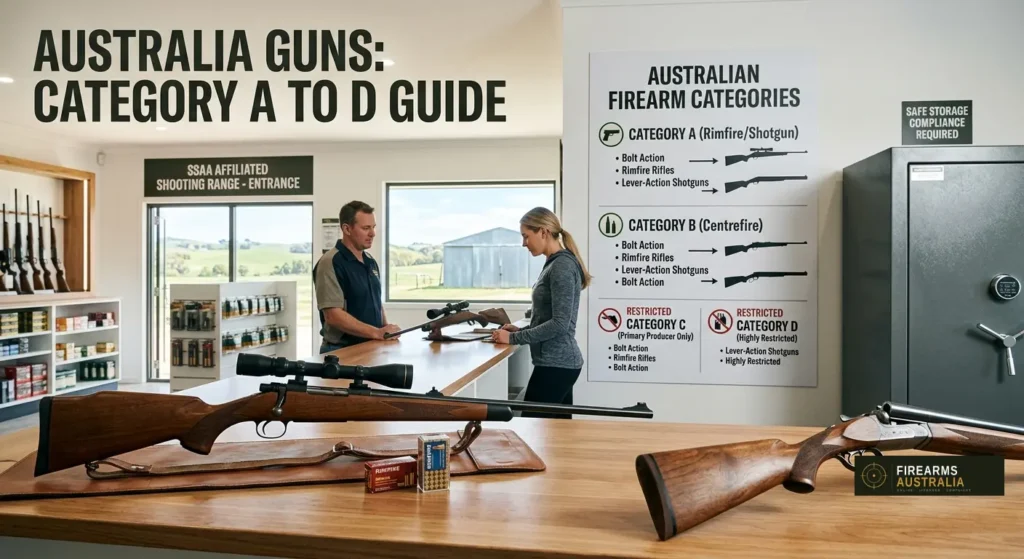
Standard longarms among Australia guns sales are split into Category A and Category B. Most first-time applicants seeking Australia guns apply for a joint Category A/B licence to secure complete operational versatility.
Category A: Low-Velocity & Manual Long Arms
Category A covers entry-level firearms designed for target practice, plinking, and small game control. These firearms feature low ballistic velocity or manual-cycling mechanisms, making them the most accessible tier of Australian guns.
-
Rimfire Rifles: Non-self-loading rifles chambered in .22 LR or .17 HMR.
-
Shotguns: Single-barrel, double-barrel, or break-action shotguns (excluding semi-automatic or pump-action mechanisms).
-
Air Rifles: High-powered pneumatic and pre-charged air guns.
Because Category A firearms have lower recoil and limited projectile range, authorities view them as essential management tools for small pests such as rabbits, foxes, and feral cats.
Category B: Centrefire Rifles & Heavy-Duty Actions
Category B encompasses centrefire longarms and lever-action shotguns with limited magazine capacities. Centrefire ammunition uses a centrally located primer, delivering significantly higher velocity, kinetic energy, and effective range.
-
Centrefire Rifles: Bolt-action, lever-action, pump-action, or break-action rifles chambered in calibers like .223 Remington, .308 Winchester, or 6.5 Creedmoor.
-
Muzzle-Loaders: Black powder rifles and traditional firearms.
-
Lever-Action Shotguns: Lever-action shotguns holding five rounds or fewer.
Primary producers and big-game hunters rely heavily on Category B rifles when managing medium-to-large invasive species, including feral pigs, wild goats, and deer.
Technical Specifications: Category A vs Category B
| Technical Specification | Category A Firearms | Category B Firearms |
| Typical Calibers | .22 LR, .17 HMR, .17 Win Super Mag | .223 Rem, .243 Win, .308 Win, 6.5 Creedmoor |
| Action Types | Bolt-action, lever-action, break-action | Bolt-action, lever-action, pump-action, muzzle-loader |
| Primary Use Cases | Rabbit control, target shooting, plinking | Deer hunting, feral pig control, long-range targets |
| Effective Range | 50 – 150 metres | 200 – 800+ metres |
| Licensing Complexity | Standard safety course + basic genuine reason | Standard safety course + centrefire justification |
Category C & Category D: Restricted Commercial Classes
Categories C and D cover rapid-firing models of Australia guns. Access to these classes is strictly limited to verified primary producers, professional pest controllers, and government culling contractors who demonstrate exceptional occupational necessity.
Category C (Restricted Longarms)
Category C includes semi-automatic rimfire rifles with magazines holding up to 10 rounds, as well as semi-automatic or pump-action shotguns with magazines holding up to 5 rounds.
Primary producers can access Category C longarms to suppress mobile pest populations on agricultural land. However, property owners must prove that manual-cycling Category A or B rifles are inadequate for their specific land management requirements.
Category D (High-Capacity & Military-Style Longarms)
Category D represents the most restricted classification for Australian guns. It encompasses semi-automatic centrefire rifles, semi-automatic shotguns holding more than 5 rounds, and lever-action shotguns with magazine capacities exceeding 5 rounds.
Private recreational shooters cannot obtain a Category D licence. Consequently, these firearms are reserved almost exclusively for professional aerial culling operators, government wildlife officers, and specialized eradication contractors.
Category H: Handgun Licensing Regulations
Category H covers handguns and target pistols under 65 cm in overall length. Due to their concealable nature, these types of Australia guns face intense regulatory oversight across all Australian jurisdictions.
┌────────────────────────────────────────────────────────────────────────┐
│                   CATEGORY H LICENSING PATHWAY                        │
├────────────────────────────────────────────────────────────────────────┤
│  1. Join an Approved Target Pistol Club                               │
│  2. Complete Probationary Period (6 Months Minimum)                   │
│  3. Log Required Club Handgun Matches Annually                         │
│  4. Apply for Category H Licence (Caliber Max: .38 / 9mm)             │
└────────────────────────────────────────────────────────────────────────┘
To secure a Category H sport shooting licence, applicants must maintain active membership in an approved pistol club for at least six months during a probationary period. Furthermore, handgun owners must meet annual competition requirements:
-
Minimum Matches: Licensees must participate in a mandatory number of official club shoots annually to keep their licence valid.
-
Caliber & Capacity Limits: Standard target handguns are limited to .38 caliber (or 9mm) and a maximum 10-round magazine capacity. High-caliber handguns (.40 or .45 ACP) require specialized metallic silhouette accreditation.
State-by-State Firearms Licensing Comparison
Although the National Firearms Agreement sets universal baseline standards for buying guns in Australia, individual state police registries enforce their own administrative procedures, genuine reason criteria, and health checks.
State Licensing Comparison Matrix
| Licensing Metric | New South Wales (NSW) | Queensland (QLD) | Victoria (VIC) | Western Australia (WA) |
| Regulatory Authority | NSW Police Firearms Registry | QPS Weapons Licensing | Victoria Police LRD | WA Police Firearms Branch |
| Minimum Age (Adult/Minor) | 18+ (Minors: 12–17) | 18+ (Minors: 11–17) | 18+ (Juniors: 12–17) | 18+ (Juniors: 12–17) |
| Land Permission Rules | Property letter or DPI R-Licence | Written landowner declaration | Property letter (min. 5 acres) | Strict WA Police Portal validation |
| Medical / Health Screening | Self-declaration | Detailed medical disclosure | Self-declaration | Mandatory FAHA Doctor Assessment |
| Individual Firearm Caps | Justification required | Justification required | Genuine need required | Strict limits (5 Rec / 10 Target) |
| First PTA Waiting Period | 28 days | 28 days | 28 days | 28 days |
Jurisdictional Nuances
-
New South Wales (NSW): Hunters can meet genuine reason requirements either through private property owner letters or by holding a Department of Primary Industries (DPI) R-Licence for public land access.
-
Queensland (QLD): Queensland permits youth shooters to enter the sport early through a Minors Licence starting at age 11. However, applicants face rigorous health screening regarding pre-existing conditions.
-
Victoria (VIC): To use recreational hunting on private property, land parcels must generally measure at least 5 acres to ensure safe shooting distances.
-
Western Australia (WA): Operating under updated legislation, Western Australia imposes numerical ownership caps (maximum 5 firearms for recreational hunting, 10 for competitive target shooting) alongside mandatory medical health assessments (FAHA).
Safe Storage, Transport & Compliance Checklist
Firearm safety in Australia does not end with licence approval. State registries conduct unannounced compliance inspections to verify that storage setups for Australia guns sales meet statutory standards.
Safe Storage Requirements
-
Level 1 Safes (Category A & B): Firearm containers must be constructed from heavy-gauge steel (minimum 2 mm thickness depending on state rules) or reinforced timber. If the safe weighs less than 150 kg empty, it must be securely bolted to the structure’s floor or wall studs using heavy-duty masonry anchors.
-
Level 2 Safes (Category C, D & H): High-category longarms and handguns require heavy-duty steel safes (minimum 3 mm to 6 mm steel construction) equipped with internal locking points and concealed hinges.
-
Ammunition Isolation: Ammunition must be locked in a separate compartment or separate container away from the main firearms.
Transport Rules
-
Firearms must be transported unloaded, encased, and out of sight in vehicles.
-
Ammunition must remain in a separate lockable container during transit.
-
Firearms must never be left unattended in a parked vehicle for extended periods.
Summary: Steps to Secure Your Firearm Licence
-
Complete Firearm Safety Course: Enroll in an accredited safety training course for your target categories.
-
Establish Genuine Reason: Obtain active club membership, landholder permission letters, or primary producer documentation.
-
Submit Licence Application: Apply online through your state’s police registry portal and pass national background checks.
-
Install Compliant Storage:Buy and bolt down a state-compliant steel safe before inspection.
-
Apply for Permit to Acquire (PTA): Once licensed, submit a PTA for your individual firearm and observe the mandatory 28-day waiting period.

Buy Firearm safe storage Australia
